
Fence Contractor in Sandy Springs, GA Built for Slopes, Clay & Georgia Storms
Building a fence in Sandy Springs isn't like building one on a flat suburban lot. You've got dense red clay that swells after a week of rain, granite hiding a foot below the surface, wooded slopes falling toward Marsh Creek or the Chattahoochee, and oaks that drop limbs every time a summer thunderstorm rolls through. Fences built without accounting for all that lean, rot, and sag within a few years. Sandy Springs Fence Installation & Repair Experts plans every fence line around your grade, drainage, and trees, so the wood privacy fence, aluminum barrier, or driveway gate you pay for stays straight and solid.
We work on the kinds of properties this area actually has: half-acre-plus wooded lots in North Springs, terraced backyards in Huntcliff, and gated estates around Riverside and Mount Paran. We also serve homeowners and businesses in Dunwoody, Brookhaven, Roswell, Vinings, and Chamblee, where HOA rules, tree ordinances, and stream buffers change from one city line to the next. Every project starts with an on-site measurement and a detailed layout, and you get a firm installation schedule before any post hole gets dug.
- ✓Bonded contractor
- ✓Fully insured on every job
- ✓Financing available
- ✓On-site measurement and detailed layout for every project
- ✓Firm installation schedule before work begins
- ✓Fast repair of damaged sections and gates
- ✓Serving a 20-mile radius around Sandy Springs
Request Your Free Estimate
No obligation. Fast, honest quotes.
Thank you — your request was sent!
A member of the Sandy Springs Fence Installation & Repair Experts team will reach out shortly. Need help now? Call (470) 684-5111.
Why Sandy Springs Properties Need a Fence Contractor Who Knows the Terrain
Sandy Springs sits on rolling Piedmont ground cut by the Chattahoochee and its creeks, under a heavy hardwood canopy, in one of the most humid climates in the country. Throw in a patchwork of city codes, and a fence that works fine elsewhere can fail here early.
Climate and Soil: 50 Inches of Rain, Red Clay, and Buried Granite
Metro Atlanta gets about 50 inches of rain a year, spread across summer thunderstorms and winter frontal systems, and summer highs in the upper 80s to low 90s come with heavy humidity. Wood stays damp, so rot, mildew, and green algae on north-facing pickets are routine. Underfoot, Piedmont red clay holds water and swells, then shrinks and cracks during late-summer dry spells. That cycle pushes shallow posts out of plumb and throws gates out of alignment. The clay is also dense and slow to auger, and granite outcrops often sit just below grade, which can mean breaking or core drilling rock. Add Eastern subterranean termites, strong UV, occasional spring hail, and straight-line winds that hit a 6-foot privacy fence like a sail, and you can see why post depth, gravel drainage, and material choice matter so much here.
Built Environment: Wooded Lots, Slopes, and Aging Pine Fences
Most of Sandy Springs was built between the late 1940s and the 1980s: ranches, split-levels, and brick traditionals on wooded lots of half an acre to over an acre. Mixed in are 1990s–2000s estate homes and a steady stream of infill teardowns with modern farmhouse styling. A lot of the fences around them are 15–25-year-old pressure-treated pine dog-ear privacy fences with leaning posts and rotted rails, or chain-link left over from the 1960s and '70s. Backyards are often terraced with retaining walls, so panels have to be stepped or racked to follow the grade. Mature oaks, tulip poplars, and loblolly pines mean digging around root zones and planning for limb falls. On infill streets, owners of older ranches want taller privacy screening as new two-story homes go up next door.
Regulations: City Codes, Stream Buffers, Tree Rules, and HOAs
The Sandy Springs Development Code limits fence height, allowing less in front yards than in side and rear yards, where privacy fences typically top out around 6–8 feet. It also enforces corner-lot sight triangles and usually requires the finished side to face out. Front-yard fences, walls, gate columns, and retaining structures may need a permit or zoning review through Sandy Springs Community Development. Near the river, the Metropolitan River Protection Act corridor (administered by the Atlanta Regional Commission) and Georgia's 25-foot state stream buffer, plus wider city buffers, restrict land disturbance. Tree ordinances in Sandy Springs, Dunwoody, Brookhaven, and Decatur protect specimen trees' critical root zones. Pool barriers have to meet Georgia's adopted IRC/ISPSC rules, and Georgia 811 has to be notified several business days before anyone digs.
Market: High-Value Homes and Quality-Focused Owners
Sandy Springs has roughly 105,000–110,000 residents, household incomes well above the state average, and plenty of homes in Riverside and Mount Paran valued well over $1 million. Many owners work at Perimeter Center or the Pill Hill hospitals. Their time is tight, and they expect clean job sites, clear paperwork, and fences that suit the house. Families with dogs need secure containment because coyotes are around and Roswell Road and GA-400 are busy. Deer pressure in Sandy Springs, Dunwoody, and Roswell drives demand for taller garden fencing. Homes also turn over fast here, so pre-listing repairs and pool-barrier fixes often come with real-estate deadlines.
Common Fence Problems We See Around Sandy Springs
Most fence failures in North Fulton and DeKalb come back to a few local causes: expanding clay, constant moisture, steep grades, and big trees. Here's what we run into most, how to spot it, and how serious it is, so you can decide whether it needs attention now or can wait until next season.
Storm and Fallen-Tree Damage Emergency
Crushed panels, snapped posts, and twisted gates from falling limbs or whole trees. It usually happens during summer thunderstorms, the remnants of Gulf hurricanes, or ice storms. A broken section leaves your yard open right away, so dogs can get out and you lose security and privacy.
Why it's common hereSandy Springs has one of the densest tree canopies in metro Atlanta. Mature oaks, tulip poplars, and loblolly pines tower over most backyards, and many have shallow roots in saturated clay. When a convective storm drops two inches of rain and then gusts hit 50 mph, limbs and whole trees come down. Ice storms do the same thing in winter. Fences along wooded property lines and creek banks take most of these hits, and insurance claims usually need fast documentation and a written repair scope.
Signs you'll notice- Panels flattened or bowed under a limb
- Posts snapped at or just above ground line
- Gate frame twisted so the latch no longer catches
- Gaps big enough for a dog to slip through
- Rails pulled loose from posts
- Chain-link fabric torn or top rail bent
We see this most along the heavily wooded lots of Huntcliff, Riverside, and North Springs. It also shows up on creek-side properties along Nancy Creek and Long Island Creek, and in Dunwoody's older canopy neighborhoods after summer storms and winter ice events.
Our fix: We secure the opening, document the damage for your insurer, and replace broken posts and panels so they match your existing fence. When damage is widespread, we'll quote a full replacement.
Leaning and Heaving Fence Posts Serious
Posts tilt, lift, or shift out of line, so whole runs lean and rails pull apart. It's usually caused by soil movement around posts that were set too shallow or without drainage, and over time the fence can lose its structural strength.
Why it's common hereGeorgia's Piedmont red clay swells when it's wet and shrinks during late-summer dry spells. Every swell-and-shrink cycle pushes and pulls on fence posts. When posts are set only 18–24 inches deep, or when concrete is poured to the bottom of the hole with no gravel for drainage, water collects and the clay pries them loose. Steep lots make it worse, because runoff washes soil away from the downhill side of each post. Tall privacy fences catch wind and add leverage on top of that.
Signs you'll notice- Fence visibly out of plumb
- Concrete footings exposed or cracked
- Rails separating from posts
- Wavy top line along a run
- Soil washed away on the downhill side
- Fence moves when pushed by hand
This is common on terraced backyards in Sandy Springs and Roswell's Holcomb Bridge corridor. We also see it on 1970s–80s subdivision fences in Dunwoody and Peachtree Corners that are now 15–25 years old.
Our fix: We reset or replace failing posts at proper depth with gravel drainage, re-plumb the line, and add bracing or stepped panels where grade and runoff caused the problem.
Rot at the Post-to-Ground Line Serious
Fungal decay where wood posts meet soil and concrete. The post can look fine above ground while it's soft and hollow just below grade. Eventually it breaks off in wind or under the weight of a gate.
Why it's common hereWith around 50 inches of rain a year and high humidity, wood near the ground barely gets a chance to dry. Pressure-treated pine set in concrete without a gravel base sits in water trapped by the clay, and decay starts from the bottom. Eastern subterranean termites are active across the region and go after softened wood. Cheaper lumber with lower treatment retention, which is common on builder-grade fences, fails fastest.
Signs you'll notice- Screwdriver sinks easily into post base
- Dark, spongy wood at grade
- Mushrooms or fungal growth at base
- Mud tubes from termites
- Post wobbles while the concrete stays put
- Gray, crumbling wood around fasteners
Rot is widespread on aging pressure-treated dog-ear fences in North Springs, Brookhaven's Ashford Park, and Chamblee. It's especially bad in shaded, north-facing yards under heavy canopy where the ground stays damp most of the year.
Our fix: We replace rotted posts with ground-contact-rated lumber or steel posts set on gravel drainage. If most posts are going, we'll recommend a full replacement.
Sagging or Dragging Gates Moderate
Gates that droop, scrape the ground, or won't latch. The causes are hinge-post movement, a racked frame, or undersized hardware. It's frustrating every day, and it's a real problem when you're keeping pets or kids in or need a pool gate to self-latch.
Why it's common hereGates hang all their weight off one post, and in shifting clay soil that post moves first. Wide wood gates built without a steel frame or diagonal bracing rack under their own weight, especially in humid weather when the boards swell. On sloped driveways and walkways, gates have to be custom-built to clear rising grade. When they aren't, they drag as soon as the post shifts even a little.
Signs you'll notice- Gate scrapes ground or patio
- Latch won't line up or catch
- Visible gap widening at top or bottom
- Hinge screws pulling out
- Gate swings shut on its own or won't close
- Diagonal gap in the frame
Sagging gates are frequent on sloped side-yard gates across Sandy Springs and Vinings. We also see a lot of them on wide double drive gates on Dunwoody Panhandle lots and on older pool gates around 1980s–2000s pools.
Our fix: We reset or reinforce the hinge post, add steel gate frames or anti-sag kits, upgrade hinges and latches, or build a new gate sized to the grade.
Non-Compliant Pool Barrier Fencing Serious
Pool fences that don't meet the 48-inch minimum height, the self-closing and self-latching gate rules, or the gap and climbability limits required under Georgia's adopted IRC/ISPSC. That's a child-safety hazard, and it can hold up a home sale or an insurance renewal.
Why it's common hereMany pools in Sandy Springs, Dunwoody, and Peachtree Corners went in between the 1980s and 2000s. Their barrier fences have aged, gate closers have worn out, and some were never fully compliant to begin with. Older owners have modified gates over the years, and clay movement has opened up gaps under the bottom rail. Home inspectors and insurers flag these regularly, often with a closing date coming up fast.
Signs you'll notice- Gate doesn't swing shut and latch on its own
- Latch mounted below required height
- Fence under 48 inches at any point
- Gaps under the fence from erosion
- Horizontal rails that act as a ladder
- Inspector or insurer flagged the barrier
This comes up most in swim/tennis-era subdivisions in Dunwoody, Georgetown, and Peachtree Corners, and with backyard pools in Sandy Springs listed for sale. Spring listing season brings a rush of inspection-driven fixes.
Our fix: We bring the barrier up to code with compliant aluminum or vinyl fencing, self-closing hinges, and properly positioned self-latching hardware. Then we close any gaps at grade.
Erosion Gaps and Pet Escapes on Slopes Moderate
Open spaces under the bottom rail where soil has washed away or where panels were never stepped to follow the grade. Dogs dig or squeeze through, and the gaps defeat the whole point of a containment fence.
Why it's common hereHeavy summer downpours run fast across the steep, rolling lots along the Chattahoochee corridor and its tributaries, carrying clay and topsoil downhill. Fences installed with level panels on a sloped yard leave triangular gaps at each step. Coyotes are active throughout North Fulton and DeKalb, and Roswell Road and GA-400 are close by, so escaped pets are a real worry here.
Signs you'll notice- Triangular gaps under stepped panels
- Washed-out channels under the fence
- Dig marks along the fence line
- Dog found outside the yard
- Exposed post concrete on the downhill side
It's common on terraced backyards in Huntcliff, Mount Paran, and Vinings Estates, and on creek-side lots in Brookhaven Fields where runoff funnels toward Nancy Creek.
Our fix: We rack or re-step panels to follow grade, add buried dig guards or bottom boards, and redirect or stabilize runoff along the fence line.
Gray, Mildewed, and Checked Wood Minor
Weathered gray boards, green algae, black mildew, and surface cracking on unsealed wood. It's mostly cosmetic at first, but unprotected wood soaks up moisture and wears out years sooner.
Why it's common hereGeorgia humidity keeps wood damp, and strong summer UV breaks down wood fibers on sunny exposures. North-facing pickets under tree canopy rarely dry out and grow algae. Most builder-installed pressure-treated pine fences were never sealed at all.
Signs you'll notice- Silver-gray faded boards
- Green or black film on pickets
- Cupping or warped boards
- Surface cracks and splinters
- Water soaks in instead of beading
We see this on almost every unsealed fence in shaded Sandy Springs and Dunwoody backyards. HOAs in Dunwoody and Peachtree Corners often send violation notices about it.
Our fix: We clean, brighten, and apply a penetrating stain or sealer, or paint, to protect the wood and restore its color. Then we recommend a resealing schedule.
Fence Installation, Gates, and Repair Services
We install, repair, and replace residential and commercial fences in every common material. Each recommendation fits your property's slope, soil, trees, and local rules. Here's how our services apply to properties around Sandy Springs and the surrounding cities.
Wood, Cedar & Privacy Fence Installation (Shadow Box, Horizontal, Board-on-Board) ⭐ Specialty
We build 6' to 8' privacy fences in pressure-treated pine and cedar. Styles include dog-ear, board-on-board, shadow box, and modern horizontal slat.
Our approachPosts go deep with gravel drainage under the concrete. We use ground-contact-rated lumber and galvanized or stainless fasteners, and we step or rack panels on sloped runs.
In Sandy Springs, GAThese are a good fit for screening older ranches from towering infill homes in North Springs and Brookhaven, and for blocking GA-400 and I-285 traffic noise. Horizontal slat fences go well with the modern farmhouse rebuilds going up all over Sandy Springs.
Best for: Homeowners who want full privacy, a warm natural look, and a fence designed for wind and grade.
Aluminum, Wrought Iron, Decorative & Security Fence Installation
We install black ornamental aluminum, wrought iron, and decorative metal fencing, plus taller security fencing for homes and businesses.
Our approachRackable panels follow slopes without stair-step gaps. We use powder-coated finishes, set posts in concrete below the clay's active zone, and match gates and columns to your design.
In Sandy Springs, GAOrnamental iron and aluminum fit the estates of Riverside and Mount Paran, and they keep wooded views open while still marking boundaries. Aluminum doesn't rot or attract termites, which makes sense in Georgia humidity.
Best for: Upscale homes, front-yard boundaries, and properties that need security without blocking the view.
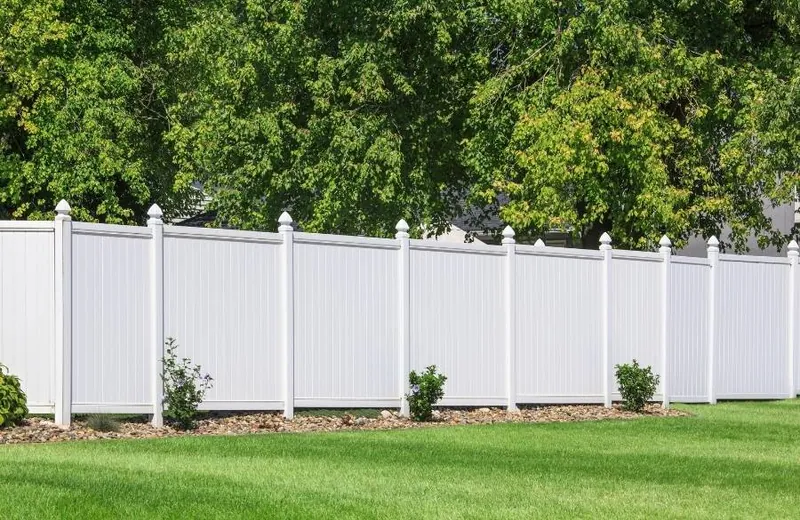
Vinyl, PVC & Composite Fence Installation
We install vinyl/PVC privacy, semi-privacy, and picket fences, along with composite fencing that looks like wood without the upkeep.
Our approachWe use UV-stabilized profiles rated for strong Southern sun and reinforce rails and gate posts. Panels are leveled or stepped with the grade so they won't sag.
In Sandy Springs, GAVinyl is a common HOA-approved choice in Dunwoody, Peachtree Corners, and Marietta subdivisions. It won't rot, mildew, or draw termites, so it holds up in humid, shaded yards where wood breaks down quickly.
Best for: Owners who want low maintenance and HOA-friendly consistency.
Chain Link, Dog Fence & Farm Fence Installation
We install galvanized and black vinyl-coated chain-link, dedicated dog containment runs, and farm and field fencing for larger properties.
Our approachWe set terminal posts in concrete and run tension wire along the bottom, and we can add buried dig guards. Fabric follows the grade so there aren't gaps under the fence.
In Sandy Springs, GABlack vinyl-coated chain-link blends into wooded lots in Sandy Springs and Roswell. Budget-friendly galvanized fencing is a good fit for rental owners in Doraville, Tucker, and Clarkston who need durability at a reasonable cost.
Best for: Pet owners, landlords, and large lots that need secure, economical containment.
Pool Fence Installation
We install pool barrier fencing that meets code, with self-closing, self-latching gates in aluminum, vinyl, or mesh-friendly designs.
Our approachWe build to Georgia's adopted IRC/ISPSC barrier rules: a 48-inch minimum height, controlled gaps, non-climbable layouts, and properly mounted latches.
In Sandy Springs, GAWe help Dunwoody, Peachtree Corners, and Sandy Springs owners with older pools pass home-sale inspections and insurance reviews, often on tight closing timelines.
Best for: Pool owners, home sellers, and families with young children.
Gate Installation, Driveway Gates, Electric Gates & Automatic Gate Systems ⭐ Specialty
We build walk gates, single and double driveway gates, and electric and automatic gate systems with openers, keypads, and remote access.
Our approachGates get steel frames and anti-sag hardware, and openers are sized to the gate's weight. We engineer custom heights for sloped drives and plan columns and footings for clay soil.
In Sandy Springs, GAGated driveway entries are standard on Riverside, Mount Paran, and Northside Drive estates. Gate columns and front-yard work may need Sandy Springs zoning review, and we plan for that from the start.
Best for: Estate homes, long sloped driveways, and owners who want controlled vehicle access.
Fence Repair & Fence Replacement
We repair storm-damaged sections, leaning posts, rotted rails, and sagging gates. When repairs no longer make sense, we tear out and replace the whole fence.
Our approachFirst we diagnose the cause, whether that's drainage, post depth, or rot. We match materials where we can, document damage for insurance claims, and haul away old fencing.
In Sandy Springs, GAFallen limbs after Sandy Springs thunderstorms, aging 20-year-old pine fences in Dunwoody, and pre-listing fixes in Brookhaven make up a lot of our repair calls.
Best for: Storm damage, aging fences, real-estate deadlines, and insurance-driven work.
Fence Staining & Painting
We clean, brighten, stain, seal, and paint new and existing wood fences.
Our approachWe pressure-clean at the right pressure for the wood, let it dry properly, and apply penetrating, UV-resistant stains or quality exterior paint. Coverage includes end grain and post bases.
In Sandy Springs, GASealing protects wood from Georgia humidity, algae, and summer UV. It's especially important on shaded north-facing fences, and it helps resolve HOA appearance notices in Dunwoody and Peachtree Corners.
Best for: New wood fences and weathered fences that are still structurally sound.
Custom Fence Design, Picket, Split Rail, Bamboo, Garden & Lattice/Trellis
We design custom and decorative fences, including picket, split rail, bamboo screening, garden and deer fencing, and lattice and trellis panels.
Our approachEach design starts from your home's architecture and the site's grade. We use proportions that suit historic and modern homes and taller deer-resistant heights for gardens.
In Sandy Springs, GAPicket and decorative wood suit Druid Hills, Oakhurst, and Vinings craftsman homes, where street-visible fences may need historic design review. Tall garden fencing keeps deer out of landscaping in Sandy Springs, Dunwoody, and Roswell.
Best for: Historic homes, gardeners dealing with deer, and owners who want a one-of-a-kind design.
Residential, Commercial & Temporary Fence Installation
We handle complete fence installation for homes, offices, retail sites, apartment communities, and construction projects, including temporary fencing.
Our approachWe coordinate scheduling around business hours and use commercial-grade posts and fabric. Temporary panels are set to secure job sites and events.
In Sandy Springs, GAWe serve businesses near Perimeter Center, apartment owners along Roswell Road, and infill builders in Brookhaven and Chamblee who need site security during construction.
Best for: Property managers, business owners, builders, and homeowners who want one contractor for everything.
Our Fence Installation Process
You'll know exactly what's happening and when. Every project follows the same five steps, from the first site visit to the final walkthrough, with local permits, utilities, and grade planned in.
On-Site Measurement and Property Assessment
- Measure fence lines and gate openings on site
- Evaluate slope, drainage, tree roots, and likely rock
- Locate visible property pins and talk through survey needs
- Discuss your goals, whether that's privacy, pets, pool, security, or style
Local note: On irregular wooded lots in Sandy Springs and Dunwoody, we often recommend confirming lines with a survey before building near a neighbor.
Detailed Layout, Material Selection, and Quote
- Provide a drawn layout showing post locations, gates, and stepping
- Compare material options and how each holds up in Georgia humidity
- Itemize pricing, including rock or slope allowances
- Review financing options if you'd like them
Local note: We flag HOA style rules, front-yard height limits, and corner-lot sight triangles before you approve anything.
Permits, HOA Approval, and Utility Locates
- Help prepare HOA architectural review submittals
- Confirm whether Sandy Springs or your city requires a permit or zoning review
- Check stream buffer, river corridor, and tree ordinance limits
- Submit the Georgia 811 locate request before digging
Local note: Projects near the Chattahoochee or local creeks, and street-facing fences in Druid Hills, may need extra review time.
Installation on a Firm Schedule
- Protect landscaping and mark tree root zones
- Auger or core drill post holes through clay and rock
- Set posts with gravel drainage and concrete, then hang panels and gates
- Step or rack panels to follow your grade
Local note: Heavy rain can soak the clay and push concrete work back. If weather changes the plan, we tell you right away.
Final Walkthrough and Care Guidance
- Check every gate for swing, latch, and alignment
- Clean up the site and haul away debris and old fencing
- Walk through the finished fence with you
- Explain staining, sealing, and maintenance timing
Local note: For pool fences, we confirm that self-closing and self-latching gate operation meets barrier requirements before we leave.
Why Sandy Springs Homeowners and Businesses Choose Us
We Plan Around Slopes, Creeks, and Clay, Not Just Property Lines
Plenty of fence crews show up with a flat-yard plan and figure out the grade on the fly. We start with the terrain. On a Sandy Springs lot that drops toward Marsh Creek or steps down through retaining walls, we lay out stepped or racked panels, place posts where runoff won't undercut them, and set them deep with gravel drainage so expanding red clay can't push them out of line. That planning is the difference between a fence that's still straight in ten years and one that's leaning after three summers.
Bonded and Insured for Your Protection
We're bonded and insured, so your property and your investment are protected while we work. That matters on high-value properties in Riverside, Mount Paran, and Huntcliff, where crews are working near pools, landscaping, irrigation, and neighbors' structures. It matters for commercial clients and property managers who need proper coverage before anyone sets foot on site, too. We're glad to provide proof of coverage before your project starts, so you can compare contractors with confidence.
An On-Site Measurement, Detailed Layout, and Firm Schedule
You won't get a ballpark number over the phone and then a surprise invoice. Every Sandy Springs project starts with an on-site measurement, followed by a detailed layout showing post locations, gates, and how the fence will handle your grade. Once you approve it, you get a firm installation schedule. For busy professionals working at Perimeter Center or the Pill Hill hospitals, knowing exactly when the crew arrives and when they'll be done makes the whole project easier to manage.
We Handle the Local Rulebook
Sandy Springs, Dunwoody, Brookhaven, Chamblee, Roswell, and unincorporated DeKalb and Cobb each have their own permitting office and fence rules. On top of that, there are HOA architectural committees, stream buffers, the Chattahoochee River corridor, tree ordinances, and historic review in Druid Hills and Decatur. We help you work through those requirements, prepare HOA submittals, and request Georgia 811 utility locates before any digging. You won't end up with a fence that violates a height limit or crosses a protected buffer.
Full-Range Specialization in Fences and Gates
Fencing is all we do, and we work in every major material: cedar and pressure-treated wood, aluminum, wrought iron, vinyl, composite, chain-link, and custom designs. That lets us recommend what fits your property instead of pushing one product. A shaded, damp backyard in Dunwoody may do better with vinyl or aluminum. A historic Oakhurst bungalow needs a properly proportioned picket. A Riverside estate may need an automatic driveway gate engineered for a sloped approach.
Fast Repairs After Storms and Before Closings
When a thunderstorm drops an oak limb across your fence or a home inspector flags your pool gate a week before closing, you can't wait a month. We repair damaged sections and gates quickly, secure open gaps so pets stay contained, and document storm damage to support insurance claims. Real-estate agents and sellers in Brookhaven, Dunwoody, and Sandy Springs count on that speed to keep their deals on track.
Financing That Makes the Right Fence Affordable
A good fence is a long-term investment. Building it right on clay and slopes, with drainage gravel, deeper posts, and better materials, costs more upfront than a builder-grade job. Financing is available, so you don't have to settle for cheaper materials that rot in Georgia humidity or skip the gate you really need. Ask about options during your on-site measurement, and we'll include them alongside your detailed quote.
Bonded, Insured, and Focused on Sandy Springs Fencing
Sandy Springs property owners expect a contractor who shows up on schedule, keeps the site clean, and builds a fence that stays straight on clay and slopes. We start every job with an on-site measurement, a detailed layout, and a firm schedule.
Bonded • Insured • Financing available
Fence Contractor Serving Sandy Springs and Surrounding Communities
We're based around Sandy Springs and serve communities within a 20-mile radius across North Fulton, DeKalb, Gwinnett, and Cobb. Every city has its own permit office, tree rules, and HOA culture, and we plan each project around the rules where you live.
Sandy Springs & North Fulton
Perimeter & North DeKalb / Gwinnett
Decatur & Central/East DeKalb
Cobb County
We serve properties within roughly 20 miles of Sandy Springs. If you're near the edge of that radius, contact us and we'll confirm coverage for your address. Not sure if we cover your area? Call (470) 684-5111.
How Much Does a Fence Cost in Sandy Springs, GA?
Fence pricing here depends on more than linear footage. Rock under the clay, steep grades, and city or HOA requirements all affect labor. The factors and example ranges below are realistic for metro Atlanta, and your on-site measurement turns them into a firm number.
Material Choice Primary Factor
Material drives most of the cost. Installed, pressure-treated pine privacy fencing is the most economical wood option, and cedar runs noticeably higher. Black aluminum and vinyl land in the middle to upper range, while wrought iron and composite sit at the top. Galvanized chain-link is the least expensive per foot, and black vinyl-coated chain-link adds a modest premium. Over a 15–20-year span, rot-resistant materials often cost less once you factor in Georgia's humidity and termites.
Linear Footage and Height Primary Factor
Total length sets the baseline, but height matters too. A 6' or 8' privacy fence needs more material, deeper posts, and more wind resistance than a 4' ornamental fence. Large half-acre-plus Sandy Springs lots often need 200–400 feet of fence to enclose a backyard. Front-yard sections are usually shorter because of height limits, but they may need nicer materials to look right from the street.
Slope, Rock, and Soil Conditions Major Factor
Steep and terraced lots need stepped or racked panels, custom-cut gates, and extra labor. Dense red clay is slow to auger, and hitting granite just below the surface can mean breaking rock or core drilling individual post holes. We flag likely rock and grade issues during the on-site measurement so you see those allowances upfront rather than as change orders halfway through the job.
Gates and Automation Major Factor
A standard walk gate adds a modest amount. Wide double drive gates need steel frames and heavier posts. Automatic and electric driveway gates are a different scale of project, with openers, power runs, access controls, and often masonry or metal columns. On sloped Riverside or Mount Paran driveways, custom fabrication to clear the grade increases cost further.
Tear-Out, Permits, and Site Requirements Secondary Factor
Removing and hauling away an old fence adds cost, especially chain-link with concrete footings. Permits, zoning review, HOA submittals, survey work, and stream buffer or tree protection requirements can add time and expense. Working carefully around specimen tree root zones can also mean adjusting post spacing or hand-digging.
| Typical project | Details | Estimated range |
|---|---|---|
| Backyard wood privacy fence | About 150 linear ft of 6' pressure-treated pine dog-ear privacy, one walk gate, mostly level Dunwoody subdivision lot | $5,500 – $8,500 |
| Cedar board-on-board on a sloped wooded lot | About 200 linear ft of 6' cedar board-on-board, stepped panels, two gates, some rock drilling, Sandy Springs | $11,000 – $18,000 |
| Code-compliant pool barrier | About 120 linear ft of 4'–5' black aluminum with two self-closing, self-latching gates, Peachtree Corners | $6,500 – $11,000 |
| Automatic driveway gate | Custom metal swing or slide gate with opener, keypad/remote access, and columns on a sloped estate drive in Riverside | $12,000 – $30,000+ |
Financing is available, so you can choose the material and gate that suit your property without paying the full cost upfront. Ask during your on-site measurement. A well-built fence adds privacy, security, and curb appeal, and it helps homes show well in Sandy Springs' competitive market. Doing it right once on clay and slopes costs less than replacing a cheap fence in five years.
Recent custom-home-building Projects in Sandy Springs, GA
Fence Installation FAQs for Sandy Springs Property Owners
How much does a new fence cost in Sandy Springs?
Most residential fences in Sandy Springs fall somewhere between about $5,000 and $18,000, depending on material, length, height, and terrain. A 150-foot pressure-treated privacy fence on a fairly level lot often lands around $5,500–$8,500. Cedar on a sloped, rocky wooded lot can reach $11,000–$18,000 or more. Aluminum pool barriers commonly run $6,500–$11,000, and automatic driveway gates usually start around $12,000. Rock drilling, steep grades, gates, and tear-out of an old fence add to the total. We give you an itemized quote after the on-site measurement, and financing is available.
Do I need a permit to build a fence in Sandy Springs?
It depends on the project. The Sandy Springs Development Code sets fence height limits (lower in front yards, typically around 6–8 feet for rear and side privacy) and enforces corner-lot sight triangles, and the finished side usually has to face out. Front-yard fences, walls, gate columns, and retaining structures may need a permit or zoning review through Sandy Springs Community Development. Properties near the Chattahoochee or local creeks may also face river corridor or stream buffer review. If you're in Dunwoody, Brookhaven, Roswell, or another city, its own rules apply. We'll help you sort out what's required before we start.
How long does fence installation take?
Most residential fences take one to four days on site once we start. The bigger variable is everything before that. HOA approval can take a couple of weeks, permits or zoning review vary by city, and Georgia law requires an 811 utility locate request several business days before digging. Steep lots, rock, or long runs can add a day or two. Heavy rain can also delay concrete work, because saturated red clay doesn't make a good base. After your on-site measurement and layout approval, you get a firm installation schedule so you know when to expect the crew.
Why do so many fences around here lean or rot after just a few years?
It usually comes down to the soil and how the posts were set. Georgia's Piedmont red clay swells when wet and shrinks in dry spells, and that movement works shallow posts loose. Posts set in concrete with no gravel underneath trap water against the wood, so pressure-treated pine rots from the bottom up, and termites finish the job. Steep lots add runoff that washes soil from around the posts. We set posts deeper, use drainage gravel, choose ground-contact-rated or non-wood posts, and step panels on slopes to prevent those failures.
How can I make my wood fence last longer in Georgia's humidity?
Seal it, keep it dry, and keep an eye on the posts. Apply a penetrating, UV-resistant stain or sealer after new wood has had time to dry, then reapply every two to three years, or sooner on sunny exposures. Trim back shrubs and vines so air can move through the boards, and keep sprinklers and mulch off the bottom of the fence. Clear leaves and soil that pile up against the pickets. Each spring, check the posts for softness, mud tubes, or leaning. Shaded, north-facing fences under heavy canopy need the most attention because they rarely dry out.
When should I repair my fence versus replace it?
Repair makes sense when the damage is limited to a few posts, a storm-crushed section, or a sagging gate on a fence that's otherwise sound. Replacement usually makes more sense when a third or more of the posts are rotted or leaning, rails are failing throughout, or the fence is 15–25 years old pressure-treated pine that's gray and splitting. Repeated patching on an aging fence often costs more over time. Act right away if a gap lets pets out, a pool gate won't self-latch, or a damaged section is leaning toward a neighbor's property.
What are the pool fence requirements in Georgia?
Pool barriers follow the International Residential Code and ISPSC as adopted in Georgia. The key rules are a minimum height of 48 inches, gates that are both self-closing and self-latching, latches mounted at a height kids can't easily reach, and limits on gaps and footholds that would make the fence climbable. Erosion gaps under the bottom rail can also put a fence out of compliance. Home inspectors and insurers often flag older pool fences in Dunwoody, Peachtree Corners, and Sandy Springs. We can bring an existing barrier up to standard or install a new compliant fence.
Do you handle HOA approval and property line questions?
Yes. We help with both. Many subdivisions in Dunwoody, Peachtree Corners, Roswell, and Marietta have architectural review committees that control material, color, height, and style. We provide the layout drawing and material details your HOA submittal needs. Property lines are trickier on irregular, wooded Sandy Springs lots, where old pins are often buried or missing. When the line isn't clear, we recommend a survey or pin locate before building, which protects you from neighbor disputes. We won't set posts until the location is confirmed.
Serving Sandy Springs, GA & Nearby
Get a Fence Built for Your Sandy Springs Property
Whether you need a full privacy fence on a sloped wooded lot, a code-compliant pool barrier, or a quick repair after a storm, it starts with an on-site measurement. Let's look at your property together.
- ✓On-site measurement of your fence lines, grade, and gates
- ✓Detailed layout showing posts, panels, and stepping on slopes
- ✓Itemized quote with rock and slope allowances spelled out
- ✓Help with HOA submittals, local permit questions, and Georgia 811 locates
- ✓Firm installation schedule before work begins
- ✓Bonded and insured crews with a clean job site
- ✓Financing options available
⚡ Tree or limb down on your fence? Call us right away. We'll secure the opening, help document the damage for insurance, and repair damaged sections and gates quickly.
Bonded • Insured